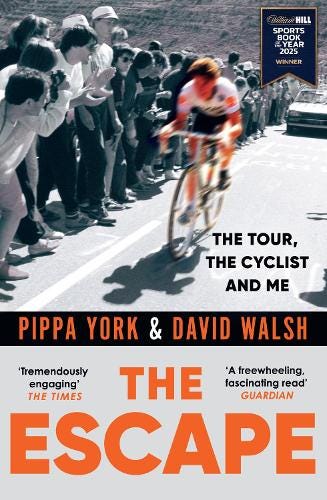
The Escape
David Walsh and Pippa York’s remarkable book turns a cycling life into a moving meditation on endurance, identity and escape.

As a child in the 1980s and 1990s, with Francophile parents, I grew up loving the Tour de France. It seemed an entirely different world of natty caps, insane mountain breakaways, and heroes like Laurent Fignon, Bernard Hinault and Greg Lemond, who were virtually unknown to the British public, aficionados apart.
The other major one-day races, along with the Tours of Italy and Spain, were as much of a mystery as the Soviet machinations behind the Iron Curtain. But for three weeks each summer we gained an insight, courtesy of Channel 4 and ITV’s highlights, into the legendary spectacle that is La Grande Boucle.
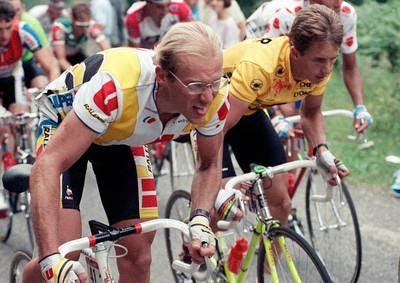
Cycling culture in the UK was not what it is now. I remember being astonished at the sight of Lycra-clad amateurs on early-morning spins while on holiday in France and the Netherlands. I was fortunate enough to witness some lesser races and one post-Tour criterium while in France, and I really enjoyed the spectacle. But once at home, I filed these experiences away as an eccentric continental pastime, like boules or electing Communist mayors.
British successes in the Tour in that era were few and far between.
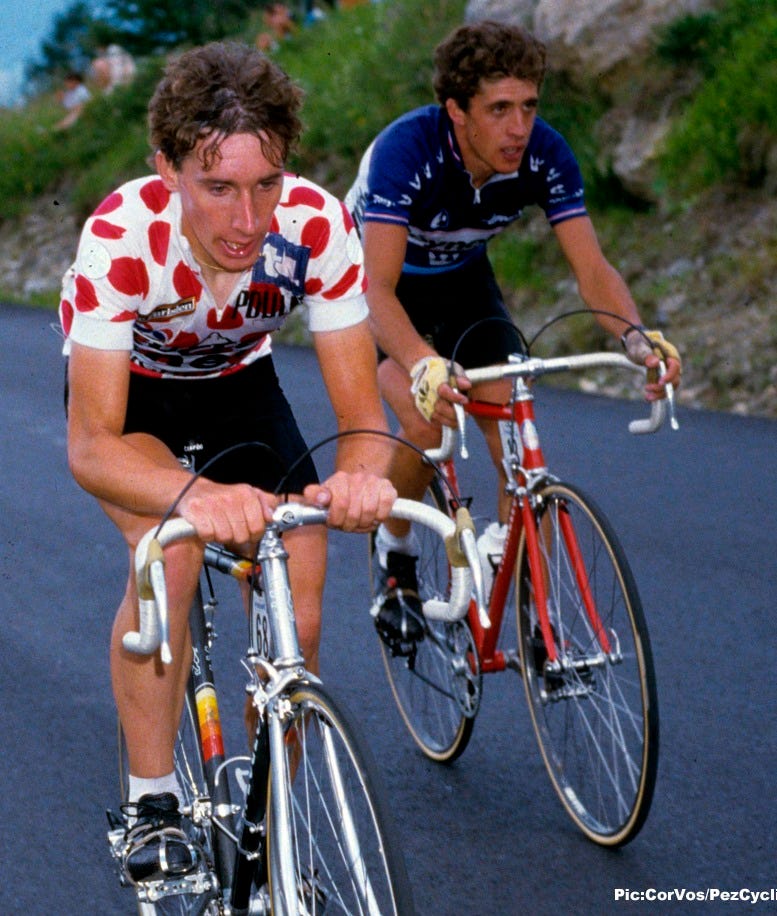
However, one exception to the rule was the Scotsman Robert Millar, winner of the polka-dot jersey in 1984. His thrilling climbs in the Pyrenees and occasional stage wins, alongside crashes and near misses, provided a home-grown angle to the coverage. What was also interesting about him was his unconventional character. Taciturn to the point of being abrasive on camera, with long hair and an earring, he looked more like a roadie for a metal band, or the sort of bloke who owns a sci-fi and comic store, than a top-class athlete.
As his career wound down and British cyclists began to make more serious inroads into the Tours in the noughties, my memory of him faded, until I came across the legendary cycling journalist David Walsh’s co-written book The Escape (2025).
This is an astonishing piece of work.
Part memoir and part autobiography, it describes Millar’s upbringing on a drab Glasgow estate, his unremarkable school life, his solitary lifestyle and, eventually, his flourishing as a cyclist almost by chance. His subsequent amateur journey to Paris and professional career are charted in stages, interspersed with Walsh’s recollections of Millar from his time covering those Tours, and his frustration with the Scot’s unquotable and prickly nature.
This would make for interesting enough reading on its own. The harsh life of the dog-eat-dog French amateur circuit, Millar’s early professional forays in smaller races for Peugeot, and his subsequent successes, integration into French life, failed marriage, and openness about the use of cortisone and other drugs in the peloton all offer fascinating insights into the often-murky world of the European cycling pro.
The forays into the 1980s and 1990s are cleverly written as a contrast with the Tours of the early 2020s and the rise of Tadej Pogačar. Walsh gives an insight into the relentlessly unglamorous life of the newspaper journalist — in his case, for The Times — covering the Tour on a daily basis: long car journeys; basic hotels staffed by French versions of Basil Fawlty, as the Tour organisation books the best accommodation months in advance; and long hours writing to deadline as the restaurants shut. Learning that the man who broke the Lance Armstrong scandal often has to settle for a kebab in a one-horse French town at midnight, while shaking bedbugs from his duvet, is not quite the image I had of the high-end sports journalist’s life on the road.
However, it is the third aspect of the book that makes it remarkable. Walsh’s companion in the car and kebab shops is fellow journalist Pippa York, who co-writes the book.
Pippa York was Robert Millar.
We learn of Millar’s painful realisation in primary school that she was different, her forays into wearing women’s clothes in secret, the subsequent discovery by her father and his attribution of her difference to teenage experimentation, and, more painfully, the hiding of her true identity in the macho world of professional sport. Millar’s journey and transition after retirement into York is a stark and honest description that opened my eyes to the bigotry and lack of understanding that many others experience while they transition — especially, in York’s case, the hounding from the British tabloid press that targeted her family and forced her to move house.
This is often heart-breaking. For example, while training alone in the Alps, Millar — then King of the Mountains and a huge star — was filming a commercial for Kellogg’s. The hotel owner’s son was in the process of transitioning, and Millar was afraid to ask about it, while desperately wanting to swap lives and live quietly as a woman.
To weave all these threads together is some achievement from Walsh. This could easily have been a simple timeline of the dramatic life led by York, but instead their relationship — sometimes spiky, always interesting — is linked to revelations about 1980s cycling, York’s insights into tactics and today’s Tour, and the mundane details of their road trips covering the racing. We gain an insight into their characters: York’s more laid-back persona after transition, Walsh’s relentless interest in Millar’s career, and page after page of immensely readable and often very touching interactions between the pair.
By the end, The Escape feels like more than a cycling book, or even a memoir of one remarkable life. That it manages to be funny, humane, technically fascinating and quietly devastating is some feat. No wonder it won the William Hill Sports Book of the Year; it is hard to imagine a richer or more deserving winner.